Hand Function (Fine Motor)
Why is Hand Function Important? Role of Occupational Therapists
Hand function is essential for carrying out daily living tasks, work, play and leisure. Limitations in hand function may restrict a person's occupational performance at home, school, work, and community living.
How Can Occupational Therapists Help?
Occupational Therapists assess hand function and identify fine motor skills that need development to achieve personal goals. Assistive equipment, prostheses, and orthoses (splints) are designed and constructed to overcome difficulties. Occupational Therapists provide developmental programs to assist with skill acquisition. A personalised approach is used to tailor therapy to the individual's goals. This allows people to do the things they want and need to do with their hands.

Fine Motor Skills--essential for daily living Hand actions relate to our social and vocational roles
"Fine motor skills"
image by
skdevitt
is licensed under
CC BY-NC-ND 2.0
Hand skills are usually complex interactions between sensory, motor, visual perception, motivation, and memory / cognitive function. Some people have less opportunity to use their hands in environments that offer little stimulation. Occupational therapists consult with aged care facilities and schools on setting up fine motor and work or play stations, and toolkits to support fine motor development.
Fine Motor Development
Usually therapy begins with:
* Assessment of a person's functional ability and their goals (what activities do they need/want to do)
* This forms a baseline which can be used for comparison
Measures of Hand Function include:
* Nine-Hole Pegboard Test (dexterity)
* Dynamometer (strength of hand grip--palmar, lateral and tripod grasps): Squegg Digital and Grip Strength measure is used through Blue Tooth with your Smart phone:
see https://mysquegg.com/product/squegg-digital-grip-strengthener-device/  Squegg Digital and grip strength device
* Goniometer: measurement of joint range of motion
* Manual Muscle Testing
* Test of Reflex Integration
* McMaster Handwriting Assessment Protocol (2nd edition)
* Peabody Developmental Motor Scales (3rd edition)
* Bruinicks Motor Ability Test (BMAT)
Occupational Therapists advise and use suitable assessment tools/protocols according to individual needs.
The Canadian Occupational Performance Measure is used for goal setting and measuring outcomes:
* Performance is measured on a 1-10 scale
* Satisfaction is measured on a 1-10 scale
Goals are usually devised within the categories of: Productivity; Daily Living Skills; Leisure/Play.
There is a developmental sequence in which children master fine motor skills--with increasingly more refined grasp, dexterity, and manipulation: transfer in the hand, and translation of objects between hands. Both speed and precision are important goals, once all the hand grips and manipulation patterns are mastered.
Assistive Equipment
Injury and disability impair hand function, so assistive equipment is trialed and recommended in the course of Occupational therapy. For example, easy-grip scissors spring open for cutting with only one hand. The item being cut may be clamped to a table (modified method).
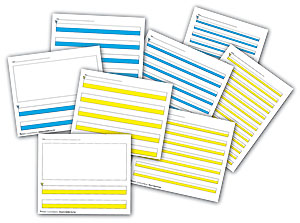
Adapted Writing Paper is sometimes used for students with visuo-motor difficulties.
There are many modified methods of carrying out tasks, and assistive equipment which the Occupational Therapist can advise on. Training in fine motor skills may involve using Smart technologies, digital applications and devices. Direct training, education, or a home program may be provided--according to the person's needs and availability.
Tasks
The choice of approaches for therapy is usually determined by the person's lifestyle, culture, values and beliefs--including personal factors (e.g. age and interests), geographical location; technology, time, and resources available. The Occupational Therapist takes an occupational history to identify tasks.
Ergonomic approaches are used for bio-mechanical difficulties. Postural stability and seating are critical to fine motor performance. Occupational Therapists consult and advise on the set-up of workstations, tasks and equipment for study and work. 
Posture is critical to hand function and can be improved with ergonomic design of the work station and task "Writing Class 1"
by
kchichester
is licensed under
CC BY-SA 2.0
Fine Motor Activities
* Construction (Lego)
* Pick Up Sticks game
* Puzzles that require grasp and in-hand manipulation, or use of two hands (bilateral coordination)
* Origami
* Crafts such as Melty Beads
* Cooking and use of tools such as cutlery, tongs, kneading, rolling pin (making a simple snack/pizza)
* Playing musical instruments (learning to play ukulele, or drumming circle, percussion, plucking)
* Making a Fine Motor Activity Box or Board, with objects for manipulation
* Tying shoelaces and doing fasteners (clips, buttons, Zips, hooks, buckles, belt)
* Leather craft, knitting, crochet, macrame
* Playing cards or games which require dexterity, and control
* Doing laundry--sorting, folding, pegging on line
* Keyboarding, or piano
* Counting and sorting objects, such as: coins
* Stringing beads / Jewellery making / Loom bands and Friendship bracelets craft
* Handwriting (Handwriting Without Tears Program)
* Woodwork to develop precision and strength of grip (using tools with various grasps)
* Carrying items in hook or palmar grasp
* Turning a key, or tap, using tweezers (daily living activities)
* Sewing--hand sewing or using a sewing machine;
* Weaving using a loom or frame
* Daily living activities such as: brushing teeth; brushing hair; cutting food; using tweezers, scissors.
* Using digital technologies and devices which involve eye-hand co-ordination
Digital Applications
- Bugs & Buttons
- Dexteria
- Little Digits
- Sky Burger
- I Write Words
- Cut the buttons
Further information on apps are provided in the Links and Resources below.
Fine Motor Olympics
Fine Motor Olympics is a resource kit of cards with photographs and fine motor activities. This provides a stimulus to challenge students to try new things and to build up their skills.
Fine Motor Tool Box Kits
A list of items to stimulate fine motor development can be provided by the Occupational Therapist to support students to work on fine motor skills throughout the day. A schedule of activities with photographs may assist students/parents/teachers to carry out a fine motor program.
Hand Therapists assess and provide therapy and orthotic devices to improve hand function. Orthoses include: braces, splints, or other artificial external devices that support the limbs or spine and/or prevent or assist desired movement.
The
suitability of fine motor activities varies from person to person.
Consult an Occupational Therapist for advice on your individual needs
for assessment, therapy, and assistive devices.
Evaluation / Outcomes
Progress is monitored throughout the consultations, and final evaluation with the Canadian Occupational Performance Measure (COPM). The duration and frequency of therapy will vary from person to person, depending on planning, discussions, budget, and progress toward goals.
Funding
In Ipswich, south-east Queensland, funding sources for Occupational Therapy may include:
* Medicare--Chronic Disease Management / Better Access to Mental Health / Helping Children With Autism / Children With an Approved Disability / Aboriginal & Torres Strait Islander Health
* National Disability Insurance Scheme (NDIS)
* My Aged Care and other over 65 years of age funding programs
* Private Health Insurance (check with your fund for Occupational Therapy cover)
* Some Schools provide Occupational Therapy consultation to students that meet requirements
* Worker's Compensation
* Community Cultural Development (e.g. Regional Arts Development Fund; Arts Programs)
Links and Resources
Apps to Develop Fine Motor Skills: https://www.sourcekids.com.au/apps-to-help-develop-fine-motor-skills/
Apps for Fine Motor Skills for Autistic Children: https://www.gympanzees.org/our-home/online-resource-hub/autism/14-of-the-best-apps-for-developing-fine-motor-skills-for-autistic-children
The OT Toolbox--Fine Motor Skills: https://www.theottoolbox.com/fine-motor-skills/
6-Pack Finger Exercises: https://ebhmc.com/wp-content/uploads/2016/07/EBHMC-Finger-6-Pack.pdf
Lego Challenge Cards from the Stem Laboratory: https://thestemlaboratory.com/lego-challenge-cards/
Handwriting Without Tears Program: https://sensorytools.net/collections/handwriting-without-tears
Find an Occupational Therapist through the Occupational Therapy Australia website (https://www.otaus.com.au/find-an-ot).
Author: Sandra Kirkwood, Occupational Therapist
mobile:(061) 0488 624 362
e-mail: kirkwood13@bigpond.com


Comments
Post a Comment